Election day is less than one month away on Tuesday, November 3. There are a ton of seats on the ballot this year, and it can be overwhelming to figure out who to vote for, while keeping track of all the other details around how to vote.
Plus, the months leading up to Election Day can be flooded with texts, emails, flyers, and knocks on your door from hopeful campaigns. While it can be tempting to ignore all the noise, this time is an opportunity for voters to get to know candidates so you can narrow down who to vote for and feel informed when you head to the polls.
Candidate Conversation Guide
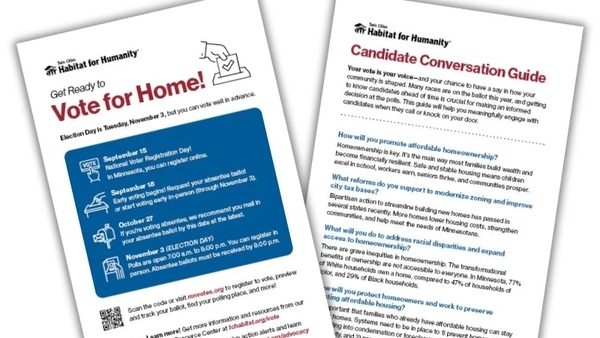
Twin Cities Habitat for Humanity's Candidate Conversation Guide makes it easier to engage with candidates on housing topics. Whether it’s at a townhall, a local forum, or right outside your front door, we encourage you to ask candidates the questions below so you can be prepared to Vote for Home!
Check out the housing questions below to learn more about what they mean and what to look for in candidate answers. Then, download the Candidate Conversation Guide and print it out to keep on your fridge, in your bag, or by your door.
How will you promote affordable homeownership?
Homeownership is foundational for families and communities to thrive. Having a decent, affordable place to call home has profound impacts beyond housing – it’s the way most families build wealth and financial stability; it allows children to do better in school, improves health outcomes, and helps build resilient communities.
Despite this, there is an affordable housing crisis across our country caused by a severe housing shortage, increased costs that have outpaced wages, and many other factors. The same holds true for our state, where more than 1 in 4 people pay more than they can afford for housing.
Meeting the need for affordable housing will take time and commitment from individuals, private donors, and public partners. Leaders at the local, state, and federal level have the capacity to tackle this in impactful ways, and now is our chance to elect candidates that want to promote, preserve, and produce more opportunities for affordable homeownership.
What reforms do you support to modernize zoning and improve city tax bases?
Minnesota currently has a patchwork of local zoning laws that make it challenging to meet our housing goals. Bipartisan action to streamline building new homes, establish clear state-wide standards, and legalize more home types in residential areas has passed in several states recently. We are hoping to get our own version in Minnesota through the Starter Home Act, which is being advocated for by the Yes to Homes coalition.
More homes mean lower housing costs, stronger communities, and more choices for Minnesotans. This effort gained momentum last session, and now we need lawmakers to help get it across the finish line. Learn more about what’s included in this bill from Yes to Homes.
What will you do to address racial disparities and expand access to homeownership?
The transformational benefits of homeownership have not always been accessible to everyone. For example, Black residents have historically faced additional barriers to achieving homeownership, such as redlining, racial covenants, and other discriminatory practices. Currently in Minnesota, 77% of white households own a home, compared to 47% of households of color, and 29% of Black households.
Our government partners have a significant role to play in addressing this housing disparity by supporting investments, programs, and policies that ensure everyone has access to homeownership.
Through our housing expertise, advocacy, and financial coaching, we effectively work alongside our government partners and community members to close this homeownership gap and expand access to homeownership. Our vision is to create a region where everyone has the opportunity to thrive.
How will you protect homeowners and work to preserve existing affordable housing?
It’s cruical that families who already have affordable housing can stay in their homes. We need to address barriers that get in the way of long-term affordability, and during times of economic uncertainty, we need systems in place to prevent homeowners from falling into condemnation or foreclosure.
Because we already need more housing supply to meet demand, we also need to make sure to preserve the affordable homes already in our housing stock. Efforts like our A Brush With Kindness program provide home repairs for income qualified homeowners and help create a safety net for many families. Supporting policies that address the rising costs of home insurance and property taxes also help ensure homeowners can afford to stay in the homes they already own.
Government leaders can be powerful partners in passing policies and funding programs like these, and we want to elect candidates that will advocate to protect homeowners.
Bonus Questions
What revenue options will you support to meet the need for reliable funding for housing?
Housing is the largest cost in the average household budget and is top of mind for many of us. Yet housing only receives a small fraction of the total state budget, which has resulted in a lack of supply of affordable homes for Minnesotans. Efforts like a constitutional amendment for housing can address this by providing ongoing, reliable funding across the housing continuum.
How will you advance affordable homeownership for our community?
The need for affordable housing is widespread, but specific barriers vary locally, and leaders should have an understanding of what is needed in your local community. Are there certain housing initiatives or priorities that are important to you or your district? Take the time to ask them about it!
What else can you do to prepare to vote?
- Register to vote. If you’ve moved recently or you’re unsure that your voter registration is up to date, you can check your registration status here. You can also register in person on Election Day!
- Make a plan to vote. There are many ways to vote. You can choose to vote early in person with an absentee ballot, or vote early by mail by getting an absentee ballot mailed to you and returning it by Election Day (you can even track it to make sure it gets there in time). Or, you can vote in person on Election Day by finding your polling place and it’s specific hours.
- Check your sample ballot. With so many candidates running for offices up and down the ballot, check your sample ballot today to find who will be running. Click here to find your sample ballot. After researching your candidates and engaging with them through the conversation guide, keep track of your choices – you can even bring your sample ballot with you to the polls!
- Spread the word! Talk to your friends, family, neighbors, and community to make sure everyone knows affordable homeownership is on the ballot this year. Many of us want to see changes in our communities, and voting is a big way you can make your voice heard!
- Let us know how your conversations go. Fill out the Candidate Response Form after engaging with candidates, and we’ll keep track of who wants to be a champion for advancing affordable homeownership. This helps us get ready for future advocacy efforts and know how to best engage with new lawmakers after they’re elected!
Check out our Elections Resource Center for more resources, and sign up for action alerts to get updates on how to stay involved.

 Eva Goldfarb
%20800x450.jpg)

 Emily Kirkevold : 1:51 PM on September 21, 2021